Posts

Showing posts with the label amerindians

Indian Aquino’s Cave

Image
In the 19th century, during the times of the Federal Republic of Central America, the Indian Anastasio Aquino led a powerful uprising in El Salvador. Aquino belonged to the Taytes (chiefs) of the Nonualco, an Indigenous tribe of the Pipil nation, and was tired of the oppression that he and his relatives had suffered for generations by the Spaniards and their decedents. In late 1832 and early 1833, Aquino was a worker on an indigo plantation where he rebelled following the arrest of his brother by the estate owner. Aquino called for disobedience to the government. He and his followers attacked army posts, recruited the Indigenous conscripts there, and burned estates all across El Salvador. They distributed spoils to the poor on their way. By the end of January 1833, Aquino managed to assemble an army large enough to do battle. His force was estimated at 2,000 to 5,000 men, armed mostly with lances, but apparently with some firearms. The revolt started in the hacienda Jalponguita, in...

The Bacabes

Image
Thousands of years ago, the creation was threatened. Humanity was in its infancy. The earth was in the form of a long gray cloud that was creeping through moist space, and it had recently condensed, giving rise to this immense ball in which everyone lived. The worst was that the sky was already crumbling, and it barely wavered under the weight of the stars, and all hope seemed to be lost. Such was the collapse, and the complaints of the earth were so numerous, that a God seriously thought of cutting off the evil and he created four giants. The four giants (figure 1) were assigned to each of the corners of the sky, and they should support it on their backs firmly. They would prevent the sky from falling while the stars strengthened their shreds of light. Figure 1. The Giants. ¹ The almighty giants are: Kan-Xibchac, the yellow is in the South. Chac-Xibchac, the red is in the East. Zac-Xibchac, the white is in the North. Ek-Xibchac, the black is in the West. They each led the mi...

Shúri “The Forgotten Warrior”

Image
In 1529, the warrior Shúri ruled Yusique (Chinameca). He belonged to the Lenca people and was a very thin cacique about thirty years old. He looked weak, but he had special physical abilities like a few people in  Cuzcatlan . He possessed the agility of the jaguar; the versatility of the deer and he was incredible flexibility as a bow. His personality was amazing because he used his brain more than pure brute force. His spirit inspired every Indian in his lands, he was considered the warlord of the warlords by his men (figure 1). Figure 1. Shúri.  ¹ At the beginning of that year, Shúri heard of some evil conquistadors taking full control of  Cuzcatlan (the western part of El Salvador) . He was concerned because of their military power and the 4-legged animals they were using to take control extremely fast. This seemed like an extremely challenging battle to win, but they had to stop them at any cost. In 1530, the situation in the central of the country got out of control ...

Cuicuizcatl and The Chinchontepec Underworlds

Image
Cuicuizcatl was a legendary Indian (figure 1), who was born in Tehuacán City and her name in Nawat means  swallow bird . Figure 1. Cuicuizcatl.  ¹ She lost her husband during the Spanish colonization as many other women and became widowed. After this, she fled with her daughter, who hid in her chest, so no one noticed she wasn’t alone. She only spoke the Indians’ language. During the following weeks, she hid in uncountable forests, jumped ravines, thorns, and wildflowers until she reached the Chinchontepec. As a newly widowed mother, she wanted to retain a low profile. Especially that the Spanish Conquistadors had kidnapped them before, and now they were fleeing from them. Cuicuizcatl walked for hundreds of km until she reached the demonized god’s abode, where water boils and dances happily when it burns in hell. She was tired, thirsty, injured by the soles of her feet that she fell with her little daughter on a bed of colored pebbles. The stars gav...

The Woman of The Chinchontepec

Image
Long ago, in the Chinchontepec surroundings, a woman of incredible beauty used to live. Unfortunately, her life was extremely tough because every time she met a new man, he got madly in love with her, wanted to marry her, and procreate his offspring with her. The woman couldn’t understand these mad situations and was losing her marbles. Plus, for unknown reasons, she could not love or feel any attraction to any of her wooers. Hence, she constantly fled from one place to another to avoid creating unrealistic expectations. One day during the dry season of 1254, the woman decided to climb to the top of the Chinchontepec to rest from her wooers. Near the crater, she decided to take a nap. Some hours passed when a young man appeared from nowhere, and immediately upon, looking at her, he fell in love as had always happened. The man tried to propose her marriage as many had attempted, but at this moment, the volcano erupted as never before. It ejected ash plumes and erupted lava as ne...

The Arbolarios

Image
Long ago, one of the most powerful Arbolarios (a genie from the storms) stole a lagoon from the north of Central America. No one was sure from where, how, and when he had stolen it. The locals merely noted an odd being flying with an eggshell over them. Several minutes passed, and when the Arbolario was flying around the Tecapa Volcano, he lost his balance, and the eggshell fell down aside. Hence the lagoon that was born nearby is tilted as the Alegria Lagoon. Many years later, the same Arbolario tried to steal Lake Güija. But this time, it was impossible because he was not strong enough and wholly gave up. Nowadays, everyone assures you; that you can only see the Arbolarios when the storms roar and emit sparks. At that moment, you will perceive a pair of baroque eyes. These eyes are from evil genies (figure 1) best known as the Arbolarios. Most probably, they are planning their next big crime. Only one thing is certain; they're going to destroy something in their way. Furthe...

Anamorós’ Snake Hill

Image
In ancient times many Indians lived in the Anamorós Hamlet called Los Ríos. The cacique (chief) hated and lived in a constant disagreement with the Anamorós’ Indians, whom he swore to exterminate. One day, the man who had sworn to destroy Anamorós. He used his using magical powers to transform himself into a gigantic snake, long and thick and went under the rocks towards Anamorós. He wanted to fulfil his promise and devastate them once and for all. He would collapse the hill, causing a tremendous avalanche that would fall on Anamorós, therefore executing all of them. On the other hand, Anamorós’s Indian cacique recognized the cruel intentions of his neighbor. He immediately decided to go to the top of the hill of his town and built protection in the shape of a small stage. Additionally, he tirelessly walked until he reached a good height on the hill, and tried to see the snake warlock, but he failed. Later in his journey, he realized he was traveling under the hill, with a st...

The Rock of Cayaguanca

Image
At the foot of the hill, there was an indigenous population. This place was ruled by a strong and bad-tempered cacique, who had a very beautiful daughter, which everyone pretended and coveted, even the character we have discovered so far. The warrior was named Cayaguanca. Cayaguanca was a powerful and respected warrior. He did not possess any wealth for which he was well unseen by the bitter and protective father. However, Cayaguanca managed to conquer the young maiden’s heart, and with his love, they met secretly. Nevertheless, you cannot hide a secret forever, and the inevitable day arrived. The cacique realized the romance between the warrior and his daughter, he was enraged and granted the order to capture Cayaguanca. After the warriors had caught Cayaguanca, the cacique ordered to fasten him to the rock and depart from it there until he died of hunger and cold, Cayaguanca’s tears were unmeasurable that flooded the indigenous tribe, then he started to become solid until he trans...

Tangaloa “The Guardian of the Sea”

Image
Many moons ago, long before the Spanish colonization of the Americas, a unique kid was born in a Lenca region called: Tangolona. He possessed unique and divine powers like a few people in the world. Everyone who met him said he could perform many miracles plus possessed surprising wisdom for his age, but he had a notorious physical malformation, he had several extra legs. For this reason, his parents never allowed him to play or meet with other kids in their town. The life of this kid was challenging and full of health problems. One day he was seriously ill, and this unfortunate and uncommon disease led him to his death. Nevertheless, because of his unique powers, he was allowed to talk with the beautiful  Moon  in his last minutes of life. During their conversation, the Moon politely asked him: “What would be your last wish, my dear?” The boy replied he had always dreamed of visiting the sea, and if the beautiful Moon allowed it, he wanted to enter the seawate...

The Tiger of Sumpul

Image
He was there. Black under the branches, the sinister face dotted with moonlight. He was clearly distinguished by the three guara feathers that he wore on his forehead; he was the Tiger del Sumpul (figure 1), that lonely and lost river that creeps under rocks and among roots, the river of crimes that have been stained so many times in blood and has heard so many cries of anguish and pain. A river of corpses and bones! Figure 1. The Tiger of Sumpul.  ¹ Right there, that man who hid behind the trunk of that gnarled tigüilote had robbed the travelers and had paid their margins with blood. He was of Mayan origin. He had been raised in the mountains, in the high mountains of Chalatenango, where the Pipil Confederation had stopped the advance of Ulmec imperialism. From the upper Cayaguanca to the gloomy Sumpul, he had traveled committing crimes. On the roadside he burned a mixture of "tapa" (datura) and tobacco leaves, the smoke of which produces sleep, delirium, and inst...

The Cocoa

Image
One day, Quetzalcoatl, the god who symbolized life, light, wisdom, fertility, and knowledge, and was considered the patron of the winds and the day, gave the cocoa tree (figure 1) to all loyal men as a reward for their love and fidelity of their wives. In those days, all men preferred to sacrifice their lives for good people before searching for quick wins and treasures. Figure 1. A cocoa tree. Cocoa was a gift from the gods that could only be consumed by the elite. The flavor of the fruit was bitter, a characteristic that the ancestors related to the suffering of Princess Cacahuaquahitl, who had died during a war. Some Indians said the cocoa was popularized when the princess died, and her blood fertilized the earth and gave life to the most splendid cocoa trees. The Olmecs ground the cocoa beans mixed with water and savored the delight of the seed in the form of a drink. Over time, the cocoa culture spread to the Mayan (600 BCE) and Aztec (1400 BCE) populations. At that t...

The Enchanted Ulupa Lagoon

Image
The Lenca people believed that from the confines of the volcano of San Miguel, a huge flying serpent came from its first eruption. On that day, the place was full of magma and ashes, and the serpent went to take refuge in the enchanted Ulupa Lagoon (figure 1). Figure 1. The Ulupa lagoon. ¹ The Ulupa Lagoon, in the Lenca language, meant: “place of the eels.” It used to look more or less circular, and apparently, it had deep waters. However, it had a unique peculiarity, from there was born a drainage stream that led its excesses to the right bank of the Río Grande de San Miguel River. The lagoon was about 5 km north of the Jocotal Lagoon, in the south or right band, and about 2 km away from the ancient road that joined the extinct populations of Xiriualtique and Elenuayquin, and shortly before reaching the prehistoric lava flows that were thrown the aforementioned volcanic towards the SE, in the direction of the San Juan Lagoon, whose last rebound cuts today The Litoral Hig...

Devil’s Pond and its twin

Image
It was the year 1510 when some of the first Spanish Conquistadors arrived at the lands of Cuzcatlan, which nowadays is known as El Salvador. They arrived with priests and nuns to convert all misbelievers from the region. In those lands, there were two ponds, one was full of odd animals, and the other was cursed (figure 1). Some of the Indians went there to worship a wicked god. He was capable of giving them all they wanted, including cocoa (their gold), power, women, sex, everything! Figure 1. Devil ’ s pond. ¹ However, there was an excessive price to pay. After a couple of days, months, or years, these people, who explored the pond and got their wishes, lost their souls, and some of them just disappeared and were never seen again. Only a couple of them were able to escape from the demon’s powers. These Indians shared that behind the pond, there is a waterfall where there is a secret entrance to the underworld (hell in the Christian world). Also, they showed everyone the ...

The Ciguanaba

Image
Many moons ago, in an ancient Maya city called Cihuatán (in Nawat), there was an attractive woman called Cozumel. Everyone knew her in all cities and towns around Cihuatán. All men were attracted to her because of her incredible smile, and black eyes that felt like you were diving into the deepest part of the ocean. Her hair was long and black, and when any man spoke to her, he melted because her voice was so sweet and soft no one could resist. Plus, she had a fantastic body that seemed surreal everyone loved her (figure 1). Some people add that she was a woman of very humble origins. Her father was a carpenter and her mother a midwife. They didn’t possess anything that anyone could envy. Figure 1. Cozumel. ¹ One day, she traveled to one of the most prominent temples: Tazumal. At that place, she was received as always with absolute pleasure and enjoyment by the inhabitants. During an important ritual, she met a warrior from that sector. They started to talk and later to dat...

The Pilona

Image
In the times when the Amerindians lived alone in the lands of Conchagua, an expected situation happened. One day, all the men gathered to give themselves the task of building a huge water container called: “The Pilona” (figure 1), at the top of a mountain called Chilagual. This was because the goddess of the waters in a dream showed their leader that in that place, he would sprout a spring that would give water to the thirsty people of the lands and their descendants forever. Figure 1. The Pilona. For the following months, the people from Conchagua worked for long periods of time without resting until they finished the Pilona. However, after they finished it, the water did not sprout as promised, not even a drop fell into the huge Pilona. After many months of an intense drought, the citizens gathered and agreed to celebrate a consecration to the goddess of the waters. During the middle of their celebration in the volcano of Conchagua, a cloud appeared in the shape of a winged...

Our Lady Saint Anne

Image
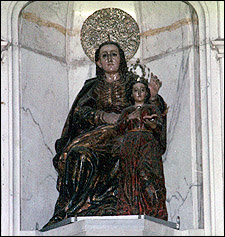
It was during the times of the Spanish conquest when a group of eight Indians was on a pilgrimage to a town called Sihuatehuacan. These faithful people were carrying a religious statue (figure 1), which was heavy and massive these days. That day the night came earlier than they expected, which forced them to spend the night in an unknown place called Santa Ana in the middle of their journey. Figure 1. Our Lady Saint Anne. ¹ The next day, as soon as the sun rose, the men who carried the statue of the Virgin decided to continue on their way. Otherwise, they would not arrive on time at the church where they had to place it. However, when they tried to lift her off the ground, they realized that there was no human power to move her. They started to ask for help, but no one was able to help them. Suddenly, an old lady suggested to them to erect a chapel there because it was a divine sign of Our Lady Saint Anne that she wanted to stay there. Nowadays, you can find the statu...

Titilcíhuat “The Fire Woman”

Image
Many years before the Spanish conquest, there was a bloody war between the Nonualco and the Mazahua tribes. Two tribes who had lived in peace and harmony for centuries till the day the Nonualco Prince made a huge mistake because he was madly in love with the Mazahua Princess and was willing to do everything to have her. One night during the dry season, the Nonualco Prince was desperate, couldn’t wait any longer, and decided to kidnap the princess and leave with her to a faraway land where they could start a new life outside their royal duties and where no one could find or know them. In the middle of that night, the prince sneaked into the princess’s room, sedated her with some pitos potion, put a black band on her eyes, kidnapped her, and vanished with her to some remote lands. Unfortunately, when they arrived at those distant lands, and the princess woke up, and they spoke, he discovered that she also loved him. At this moment, they were frightened and knew this was the beg...

The Almighty Tlaloc

Image
Many moons ago in the Americas, there were several gods, but one of the most important was Tlaloc. He was the god of rain, earthly fertility, and water. All Aztecs and the Salvadoran Pipil people worshiped him from the Teotihuacan’s times. Tlaloc operated in all four heaven areas called Tlalocan, located in the east of the universe, from each area shed a different type of rainfall. Plus, from this paradise, he sent the beneficial and necessary water for all Indians on Earth, so their crops could grow greatly! In  Tlalocan,  Tlaloc lived with his two wives: Xochiquetzal,  the goddess of love, flowers, arts, pleasure, and nature. Chalchiuhtlicue , the goddess of water, rivers, seas, streams, storms, and baptism. And his five children, four boys called  Tlaloques,  and his daughter  Huixtocihuatl . Also, some people shared Tlalocan with Tlaloc, the unlucky, but good ones who perished accidentally by drowning or by dropsy. Here, some permanent crops of all kin...

The Red Corn

Image
In the year 1123, there was a lot of happiness in El Salvador. The rains had fallen with love; the moon had illuminated the rivers making them silverish, the Indians threw the grains of white corn, and even as Sihuapil’s teeth on the soil shelled in waves by the plow. During this year, timid little leaves covered the soil from drinking and breathing the moon. They grew and grew. One day, the goddess Sucuxi decided to visit the Indians. She was so beautiful by her dark skin, so good by her simplicity, and so pure by her naiveness. On that day, she looked from the top of a hill, at every hard-working Indian. In reward for their efforts, she wanted to give them a more gallant harvest. She descended from the hill to the cornfields that already gave ears of corn and wanted to make their stems taller than an Indian. Sucuxi began to walk through those cornfields that were crazy with joy when they heard the hymns of the wind, but between the stems of corn, a bush that had buste...

The Pond of Bululú

Image
According to an ancient legend in the Sensunapán River, there is a well-known pond called Bululú (figure 1). This pool is enchanted because a golden crate contains a paste filled with diamonds and silver soap. Figure 1. The pond of Bululú. ¹ These objects belonged to an Indian princess, who one day went for a walk around the place. She had an unmeasurable loved for this river.  One day, she took a bath in the lowest part, when suddenly, she carelessly slid on a rock and could not swim back. Unfortunately, she drowned in that place, and no one knew about it. Days later, some curious Indians came to the pool and wanted to seize the Princess’s belongings. However, mysteriously when they tried to touch them, they disappeared and appeared on the other side of the pond while they heard some giggling laughter from somewhere, but they couldn’t see anyone. They fled as fast as possible from there! The elders say, the one who can touch them submerges in the pond and cannot l...