Posts

Showing posts with the label spaniards

The Plain of The Dead Man

Image
A long time ago, the Spaniards started to conquer the lands of El Salvador. One of the last strongholds of the Lenca tribe was the Morazan, and they had to protect it at any cost. The Spaniards were tired of the Lenca tribe and decided to carry out a massacre. Eventually, all corpses were reclaimed by other Indians except one. Nobody ever claimed nor picked up. No one ever knew who he belonged. For this reason, the new locals called this place the Plain of the Dead Man  (El Llano del Muerto in Spanish) (figure 1). Figure 1. The Plain of the Dead Man.  ¹ Nowadays, the Plain of the Dead is a place with abundant natural wealth, full of forests, rivers, and mountains that offer tourists a good space for camping, hiking, and swimming in pools of crystal-clear water. Credits: ¹  Natalia Galarza

Atlacatl, The Last Lord of Cuzcatlan

Image
When Pedro de Alvarado arrived at Atehuan (Ateos) he received a message from Atlacatl (figure 1) in which he accepted his surrender since they had taken control of a large part of the territory. Figure 1. Atlacatl. ¹ Pedro de Alvarado was extremely surprised by such a fast surrender since Atlacatl was one of the mightiest chiefs. However, he still agreed to visit Atehuan and take control of it. However, when he arrived, he found the entire town in revolt since all the Pipil people had fled to the mountains. Pedro de Alvarado was angry and sent a letter to Atlacatl asking him to surrender for good. However, Atlacatl replied: "If you want our weapons, come and bring them to the mountains." The conquistador was furious and on July 4, 1524, attacked all surrounding mountains. Many horses, Spaniards, and indigenous people died. However, Atlacatl survived and never bowed to any foreign authority, and from the mountains, he kept attacking the invaders. Pedro de Alvarado tried to cap...

Shúri “The Forgotten Warrior”

Image
In 1529, the warrior Shúri ruled Yusique (Chinameca). He belonged to the Lenca people and was a very thin cacique about thirty years old. He looked weak, but he had special physical abilities like a few people in  Cuzcatlan . He possessed the agility of the jaguar; the versatility of the deer and he was incredible flexibility as a bow. His personality was amazing because he used his brain more than pure brute force. His spirit inspired every Indian in his lands, he was considered the warlord of the warlords by his men (figure 1). Figure 1. Shúri.  ¹ At the beginning of that year, Shúri heard of some evil conquistadors taking full control of  Cuzcatlan (the western part of El Salvador) . He was concerned because of their military power and the 4-legged animals they were using to take control extremely fast. This seemed like an extremely challenging battle to win, but they had to stop them at any cost. In 1530, the situation in the central of the country got out of control ...

The Rock of The Conquest

Image
Hundreds of years ago, in the Canyon of the Olotes (Barranca de Los Olotes in Spanish)  near Izalco, cruel combat happened between the Spaniards and the Indians. On a terrible afternoon, thousands of arrows darkened the sun, trying to stop the Spanish invaders who had come with Pedro de Alvarado, one of their best captains. However, the Spaniards were able to protect themselves with their shields and laugh about their useless weapons. After a while, the Spaniards started to move their forces, and little by little, using their sophisticated  weaponry , they defeated the Indians. After the fight was over, Pedro de Alvarado decided to take a rest because it was insanely hot. However, the heat was so extreme that the rock softened and imprinted his right foot as a sign of their evil precise. Nowadays, everyone living in the Canyon  of the Olotes can appreciate the engraved foot (figure 1) as a memory of the old times and the Spanish Conquest. Figure 1. The Rock of The Conques...

The Pirate Treasures of Meanguera Island

Image
Long ago, Sir Francis Drake hid many of his treasures around the new Indies. One of these places was Meanguera Island. A place where he buried some of his finest treasures. Meanguera Island was a unique place for Sir France because it was considered a mystical land and had been inhabited long before the Spanish conquest, mainly by the Lenca and the Potones. In the year 1522, they discovered it in the expedition of Andrés Niño. Under the jurisdiction of Gil Gonzales de Dávila. He named this sector Petronila to honor Burgos bishop’s niece, who possessed the title of President of the Council of Indies, Fray Juan Rodrigo de Fonseca. Hence the current name of the Gulf of Fonseca. One day, the Spaniards discovered that Sir Francis had heard the rumors that Sir Francis had hidden some unique treasures while he was circumnavigating the Earth and stole all gold and gemstones from Meanguera, Tecapa, and Conchaguita. He was extremely greedy and thought he would return one day to collect them...

Cuicuizcatl and The Chinchontepec Underworlds

Image
Cuicuizcatl was a legendary Indian (figure 1), who was born in Tehuacán City and her name in Nawat means  swallow bird . Figure 1. Cuicuizcatl.  ¹ She lost her husband during the Spanish colonization as many other women and became widowed. After this, she fled with her daughter, who hid in her chest, so no one noticed she wasn’t alone. She only spoke the Indians’ language. During the following weeks, she hid in uncountable forests, jumped ravines, thorns, and wildflowers until she reached the Chinchontepec. As a newly widowed mother, she wanted to retain a low profile. Especially that the Spanish Conquistadors had kidnapped them before, and now they were fleeing from them. Cuicuizcatl walked for hundreds of km until she reached the demonized god’s abode, where water boils and dances happily when it burns in hell. She was tired, thirsty, injured by the soles of her feet that she fell with her little daughter on a bed of colored pebbles. The stars gav...

The Cocoa

Image
One day, Quetzalcoatl, the god who symbolized life, light, wisdom, fertility, and knowledge, and was considered the patron of the winds and the day, gave the cocoa tree (figure 1) to all loyal men as a reward for their love and fidelity of their wives. In those days, all men preferred to sacrifice their lives for good people before searching for quick wins and treasures. Figure 1. A cocoa tree. Cocoa was a gift from the gods that could only be consumed by the elite. The flavor of the fruit was bitter, a characteristic that the ancestors related to the suffering of Princess Cacahuaquahitl, who had died during a war. Some Indians said the cocoa was popularized when the princess died, and her blood fertilized the earth and gave life to the most splendid cocoa trees. The Olmecs ground the cocoa beans mixed with water and savored the delight of the seed in the form of a drink. Over time, the cocoa culture spread to the Mayan (600 BCE) and Aztec (1400 BCE) populations. At that t...

Devil’s Door

Image
Everything started in 1822 in the church of Panchimalco, which was already built and was headed by a priest named Francisco, a native of Valladolid, Spain. He was a member of the order of Saint Francis of Assisi. Two years later, Mr. Rosendo Renderos came from Valencia with his daughter Maria de la Paz. He had many servants and a lot of money to buy lands in El Salvador. The Valencian was a widower. However, he had Maria de la Paz, his daughter, a young graceful whose unusual beauty impressed the natives, who said that he had “the same eyes and the same face as the virgin of the church of Panchimalco.” The Renderos family lived for a while in the same convent, until Mr. Rosendo found what he was looking forward to not so far from San Salvador more or less 10 km. He bought some land surrounded by hills near the convent of Panchimalco. His intention was to plant orange trees with the Valencian seeds he had brought. The servants and patron set to work preparing the land to sow t...

The Living Rock of Nahuizalco

Image
During the Spanish Conquista, a Lord tried to force Prince Atonal’s daughter to become his slave. She was a woman of magnificent beauty and indomitable will. Her name was Atlakaki, which means “The Indomitably.” In addition, this Lord wanted to abuse her and turned her into his concubine. However, she told him that she would never be the wife or slave of any invader! She said to him that if he respected her life, she would prepare something delicious to eat for him. The prominent Lord suspected that proposal, but he accepted the offer. The lovely princess prepared the special food and arranged to serve it to him and his guests. During dinner, the Spaniard took a huacal. Later, he called a slave, opened his mouth, and gave him a cup of the atole. The boy had not finished the drink when he fell to the floor with pain, and foam came out of his mouth. The Lord uncovered the princess’s trick and realized there was a mix of coral snake venom to kill him. Atlakaki was imprisoned and...

Lake Coatepeque Snake

Image
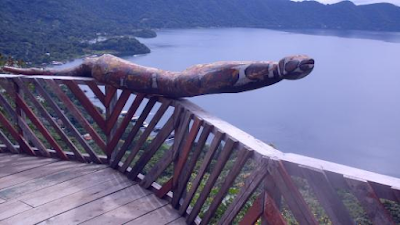
In the Lake Coatepeque in El Salvador live a magical snake (figure 1), so massive, and so powerful that all people are scared of it. Some Salvadorans said it looked like a basilisk because it has horns but is partially blind because the Spaniards cut one of its eyes during a war. Figure 1. The snake. ¹ Nowadays, it hibernates in the lake abysses waiting for its return to the surface to continue petrifying more people with its powers. One day the inhabitants said from the year 1700 and beyond the snake started to snort yearly, when this happens, the waters trembled and shook, and everyone can hear the rumblings. Many Santanecos think this is the reason for the powerful quakes that shake Central America. After the snort stops, they assure they cannot stand the sulfur smell that they perceive in the place for three days, a smell the inhabitants associate with hell. They consider the snake came from there. Plus, snort causes the inhabitants to be baffled for many days. ...

Prince Atonal

Image
Long ago, Cuzcatlán had different provinces, which had been appointed by chiefs. They were the local leaders and owed obedience to the Lord of Cuzcatlán. Prince Atonal governed the Izalco area. In Izalco, Atonal had the mission to confront the Spanish invaders and every Indian who joined them in the conquest of Cuzcatlán in 1524 (figure 1). One night, in his council, Atonal took the floor and exclaimed: “My life for our people. Oh, great Lord.” This declaration manifested immense satisfaction in the Atlacatl (the last lord of Cuzcatlán). Everyone presented the spirit of struggle and solidarity as never before. Figure 1. Prince Atonal vs the Conquistadors. ¹   Atonal and his assistants prepared the strategy that was to stop the invaders. He placed a few spies along the coastal paths from the River of La Paz to Caluco. Also, he put a parapet between Mochicalco and Acatepeque, where he placed a Calpulli (a small combat unit composed of a dozen of the best Pipil warriors). ...

The Bandari Witch

Image
In the 1600s, a poor old woman from the Santa Ana Volcano surroundings was expelled from her lands by the Conquistadors. They stole all that she had and laughed about how poor she was and how she looked like a bandari, they said: “You are just a bandari, get out of here and come back to the jungle with your relatives! You cannot even speak Spanish!” While she was walking around the place for days without food or water, she was starving near the lake when she met an elegant white man wearing a black coat, who asked her: “Dear, why are you so lonely? Did anything happen to you?” She was very surprised and thought she was suffering from some hallucinations because she had been in that place for days and never seen anyone and he spoke her language too. She felt some shivers from the presence of that man. However, she answered that she was expelled from her house and lost everything in the hands of some evil Spaniards. The man was thoughtful and for a while gave her a piece of bread fro...